KS1 Resource – Notes For Living on Planet Earth
by Oliver Jeffers
About the author
Oliver Jeffers is a highly acclaimed children’s picture book writer. He was born in Australia but spent much of his early life in Belfast, Northern Ireland. He gained a first-class honours degree in illustration; he is still painting in a range of styles and sizes. His work includes illustrating book jackets, album covers, a commission from Lavazza coffee company to paint pictures for their HQ and more recently one from Starbucks to produce illustrations for the UK in-store displays. He started writing and illustrating children’s picture books when he realised that people didn’t believe what he did with his time. His debut picture book ‘How to Catch a Star’ and the beautiful follow up Lost and Found were huge successes. The latter won The Nestle Children’s Book Prize Gold Award in 2005.
About the book
A handbook, a lullaby, a missive or a little bit of everything?
Since the publication of Oliver Jeffers first picture book, How to Catch a Star, I have been a fan. I eagerly await the next publication, always pre-ordering, and I am never disappointed – though I have some favourites! And this month Oliver Jeffers has added another title to his growing list of beautiful children’s picture books. His latest book Here We Are: Notes for Living on Planet Earth is a gentle, heart-warming look at the world we live in. This book is dedicated to his son, Harland, and was written in the first two months of his life. Notes for Living on Planet Earth is intended to be a personal and useful guide for Oliver’s young son to growing up on Planet Earth. This book sends a strong message about respecting what we have and those that have it; ultimately, the importance of valuing the world that we live in. This is a perfect book for sharing, the beautiful illustrations, typical of Jeffers, invite you to immerse yourself in the many wonders of the world. The simple, poetic, yet humorous text and the accompanying illustrations translate many big, difficult ideas into something that can be read and understood by all. A sincere, thoughtful book which I anticipate would be a book in which children would lose themselves; pouring endlessly over the illustrations; wondering, pondering and musing about the beauty of the world, its people and animals. Make sure you read the quotes and the inscription; I particularly love the contribution from Oliver’s dad which I am sure carries today.
Suggested ideas for using the book
Before reading – The Book Hook
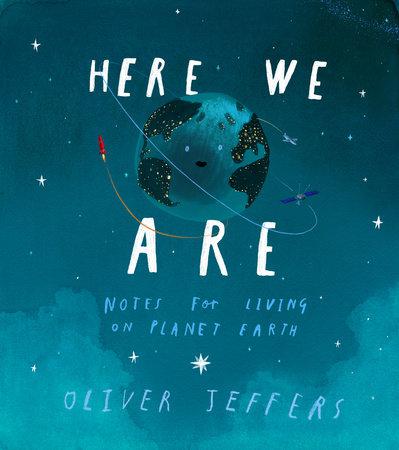
Cover the front of the book with a black piece of card. Ensure you have cut a small window in the card which will reveal part of the Earth. Invite the children to share with you their ideas – What is it? Or scan the image and set up as a slow reveal on the smart board. Slowly reveal the front cover encouraging the children to keep sharing and refining their ideas as they see more of the cover.
Introduce the book
Look at the front cover
What do you think this book is going to be about? Why?
Is this fiction or non-fiction book? Why?
Tell me about the picture on the front of the book.
What title would you give this book?
Read the book blurb – does the blurb provide any further clues?
Here We Are – who does we refer to?
During reading
Book discussion – Do not use all the questions but select the most appropriate to provide opportunities for quality discussion. The questions are intended to encourage the children to think deeply about the text. At all stages invite all the children to make contributions – ones which can be added to. Avoid asking the children too many closed questions as this stops children from thinking.
Activating Prior Knowledge | This book reminds me of a time I … This book reminds me of when I read … This book makes me think about … |
Prediction | Look at the inside front cover. When you saw the front cover what did you think this book was going to be? What made you think that? Now you have read the inside is it what you expected? What do you think this book is going to be about? Why do you think that? Tell me more. I think think this book is going to be about … Because …. Support children who may be finding it difficult to predict with a choice of either /or Will this book be about cats or about Earth and its inhabitants? |
Visualisation | Share the text without showing the illustrations. When you were reading this book did you ‘see’ the story happening in your imagination? Were your pictures the same as Oliver Jeffers’ illustrations? |
Summarising | What will you tell your friends/ another class about this book? |
Questioning | Using Aidan Chambers ‘Tell Me’ Booktalk What do you like about this book? What do you dislike? What do you find interesting? What do you find unusual about this book? Is there anything in this book that surprises you? How do you know? What makes you think that? What question would you like to ask the author? What is your favourite part of the book? Which is your favourite picture? Why? Is there anything you don’t like about the book? Has anyone noticed anything they want to tell us? What do you think the purple adult is saying to the baby he is holding? What does this page make you think about? Were you surprised by something that someone else said? Record the children’s thoughts, ideas, and comments. Respond to their ideas with your own comments and invite other children’s comments which will enable the children to think deeper about the text. |
Vocabulary | Tell me – which is your favourite word/s or phrases. Do you find any of the words unusual? Do you find any of the words interesting? When reading this book were there other things to do with words/ language you didn’t like? |
Structure / Analysis | Were there any patterns or connections you noticed? Where did the story happen? What makes you think this? |
Interpretive Strategies | Tell me what does this book make you think about? (THEME) Tell me what you think the author is trying to say to you? How many different stories can you find in this story? Whose story is this? Who is this story for? Who is telling this story? If Oliver Jeffers asked you what could be improved with this book what would you say? |